
Colorful Wedding Bands: Emerald, Sapphire, Morganite, Amethyst, Opal & More
A wedding band does not have to disappear beneath an engagement ring. Emerald leaves, blue Sapphire, vivid Pink Sapphire, soft Morganite, purple Amethyst and White Fire Opal can turn the band itself into an important part of the finished bridal design.
The Wedding Band Can Continue the Engagement Ring or Change It Completely
Curved and open wedding bands solve a practical problem, but the most interesting designs do much more than create space around a center setting.
A botanical band can extend the leaves and natural imagery already present in an engagement ring. Emerald can introduce saturated green beneath a clear center. Sapphire can add classic blue. Pink Sapphire and Black Gold can turn the entire stack toward gothic romance, while Morganite and Rose Gold create something softer and more delicate.
Opal adds another possibility entirely because its flashes are not one fixed color. White Fire Opal can introduce pink, green, blue and golden flashes without committing the stack to one dominant hue.
Clear gemstone bands take the opposite approach. Instead of changing the palette, they allow the shape of the contour to become the main contribution.
The choice is therefore about more than finding a band that physically fits. It is about deciding what you want that band to add to the finished ring set.
Four Ways to Build a More Personal Wedding Stack
Leaves & Branches
Sammi and Hye use marquise shapes, open space and organic lines to create wedding bands inspired by vines, leaves and growing branches.
Emerald & Sapphire
Nesa and Mesa use saturated green and blue for wedding bands that become obvious parts of the engagement-ring color story.
Pink, Purple & Opal
Morganite, Pink Sapphire, Amethyst and White Fire Opal create softer or more expressive alternatives to a traditional clear stone band.
Clear Gemstones
Kayi and Jenna let the contour remain the main design feature for someone who wants sparkle without introducing another strong color.
Round Gemstone Curve or Pear Cut Center?
Nesa and Mesa demonstrate how changing the gemstone arrangement can transform the same color palette.
Nesa uses three round colored gemstones within a curved nesting band. The design feels balanced and relatively light, allowing the engagement ring to remain the primary focal point.
Mesa introduces a pear cut gemstone at the center. The pointed stone draws the eye directly toward the middle of the stack and gives the wedding band much more visual authority.
Choose Nesa
If you want Emerald, Sapphire or Pink Sapphire to frame the engagement ring without creating another dominant center.
Choose Mesa
If you want the wedding band itself to contribute a distinctive pear shaped focal point to the finished bridal stack.
20 Ways to Add Shape, Color & Personality
From Emerald leaves and Morganite branches to Black Gold Pink Sapphire, Amethyst curves and White Fire Opal crowns, these wedding bands show how dramatically the companion ring can change a bridal set.

Sammi Curved Gemstone Leaf Band Sterling Silver
Sammi uses marquise cut gemstones like small leaves along a winding curved vine. Sterling Silver keeps the design cool and neutral, making it easy to place beside a wide range of engagement-ring gemstones.

Sammi Curved Emerald Leaf Band Sterling Silver
Emerald makes Sammi's leaf motif even more obvious. Marquise green stones follow the Sterling Silver curve like a small botanical branch beneath the engagement ring.

Sammi Curved Emerald Leaf Band Rose Gold
The same Emerald leaf pattern feels warmer against Rose Gold. Green and blush metal create a romantic botanical contrast rather than the cooler forest look of Sterling Silver.

Noah Curved Morganite Stacking Band
Morganite gives Noah a softer personality. The curved arrangement creates space for an engagement setting while Rose Gold keeps the entire palette warm, blush and romantic.
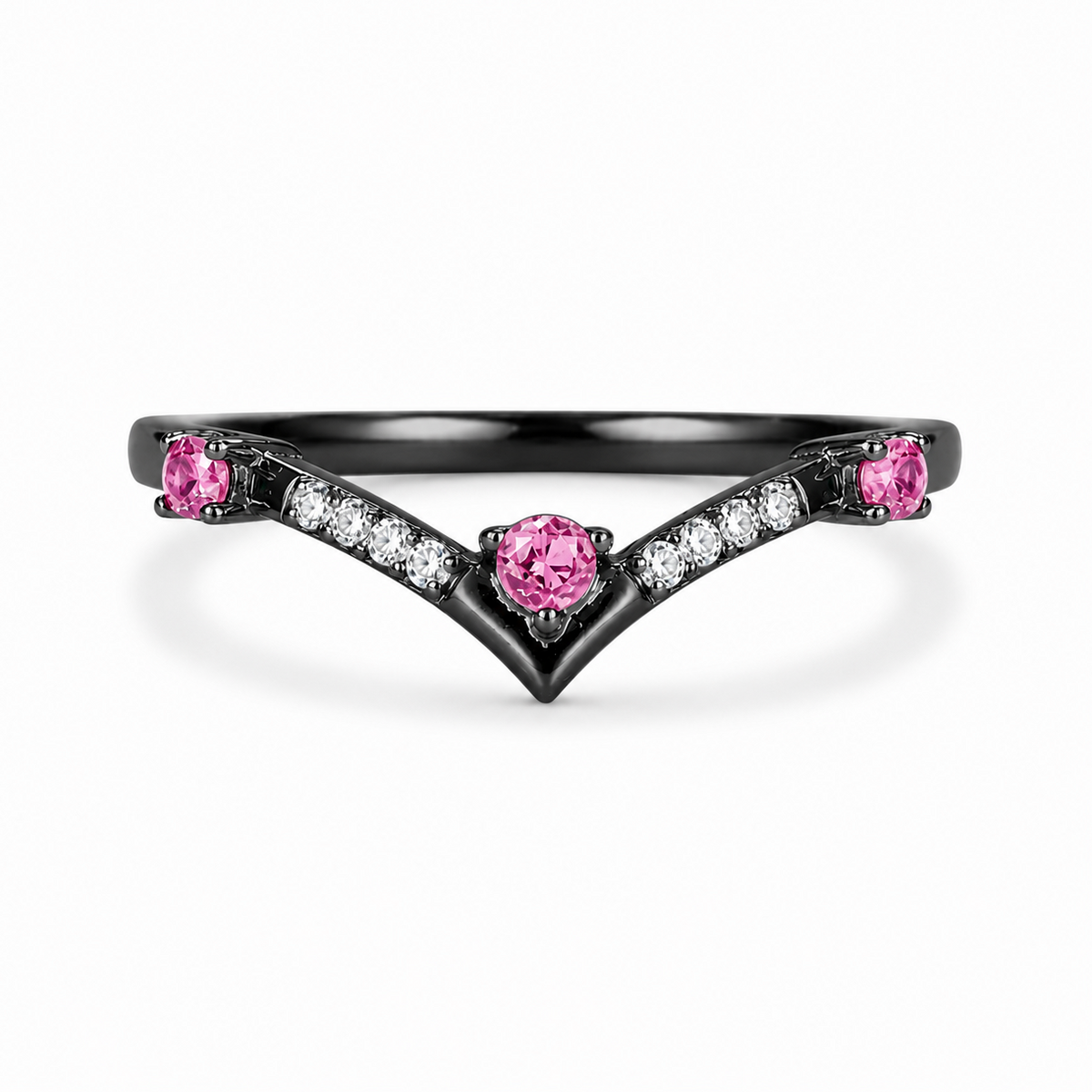
Nesa Pink Sapphire & Black Gold Band
Pink Sapphire becomes dramatically different against Black Gold. Three round pink stones sit within the curve while bright accents create sharp contrast against the dark metal.

Nesa Curved Wedding Band Sapphire Ring
Three round blue Sapphires create a strong line of color inside Nesa's curve. Rose Gold makes the blue more noticeable through warm and cool contrast.

Nesa Curved Emerald Band Sterling Silver
Emerald gives Nesa deep green color without using an obvious leaf motif. Sterling Silver keeps the design crisp and allows the gemstone color to remain the strongest element.
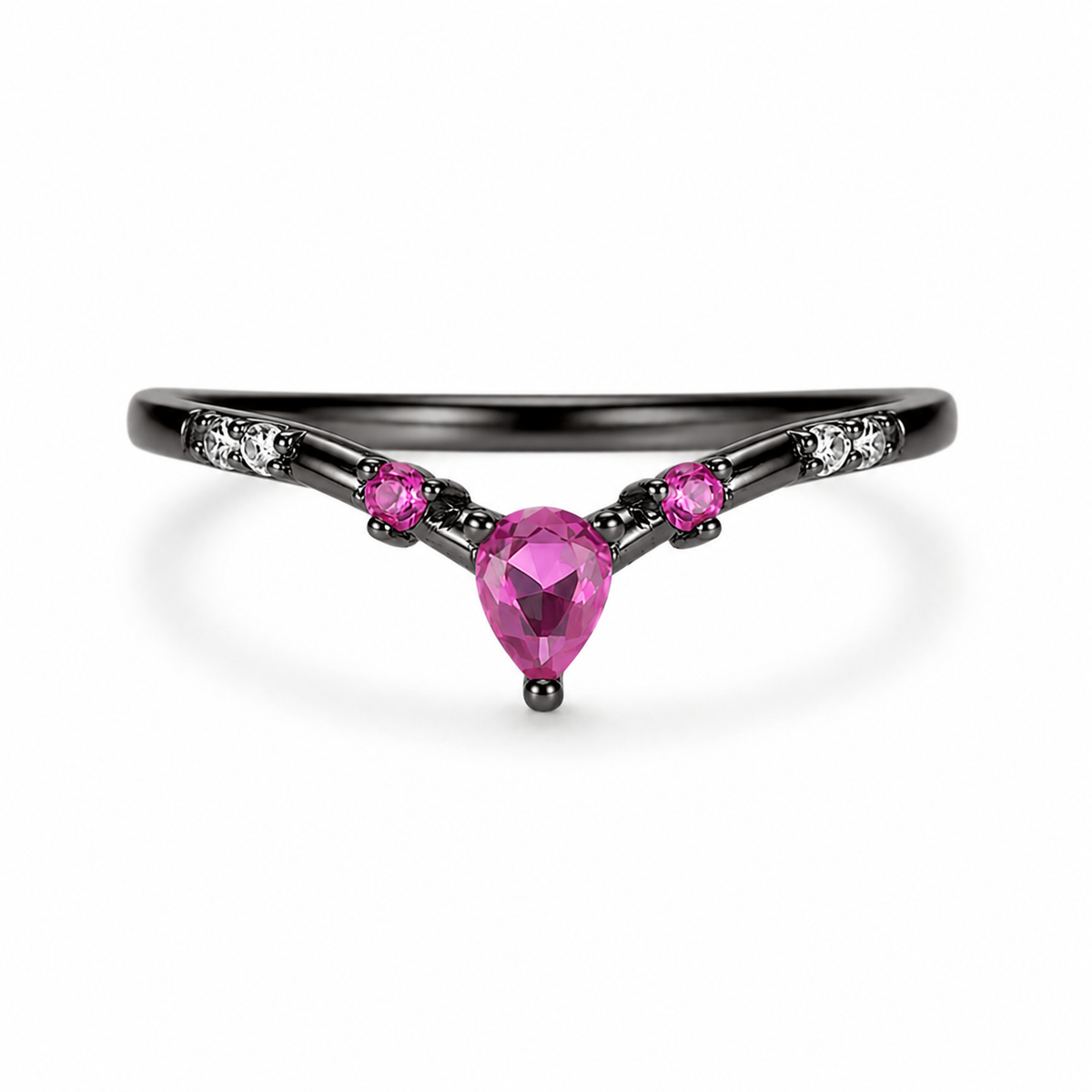
Mesa Pink Sapphire & Black Gold Band
Mesa gives Pink Sapphire a stronger focal point through a pear cut center. Against Black Gold, the vivid pink becomes even more dramatic and the wedding band becomes an obvious part of the stack.

Mesa Curved Wedding Band Sapphire Ring
A pear cut blue Sapphire sits at the point of Mesa's curve, surrounded by smaller Sapphire and clear accents. The pear shape gives the band more visual weight than Nesa's three round stones.

Mesa Curved Emerald Band Sterling Silver
Mesa's Emerald version places a pear shaped green gemstone at the center of the curve, allowing the wedding band to become a focal point rather than simply a sparkling frame.

Kayi Curved Gemstone Stacking Band Rose Gold
Kayi returns to a neutral palette with a pointed marquise center accent and small sparkling stones along the V. Rose Gold adds warmth without introducing another gemstone color.

Karma Curved Amethyst Stacking Band
Purple Amethyst gives Karma a defined violet color story. Bright accents keep the design lively while Rose Gold adds warmth around the purple stones.

Joan Curved Opal Band Rose Gold
White Fire Opals follow Joan's gentle curve, introducing shifting flashes of color without creating a large crown beneath the engagement ring.

Jenna Curved Gemstone Stacking Band Sterling Silver
Jenna keeps the wedding band visually quiet with a graceful curved silhouette and clear gemstone accents. Sterling Silver makes it an easy partner for cool toned engagement rings.

Jenna Curved Gemstone Stacking Band Gold
Gold changes Jenna from a cool neutral into a warmer bridal band while preserving the same simple curved shape and clear gemstone sparkle.

Isa Curved Opal Band Rose Gold
Isa gives White Fire Opal a more pronounced crown silhouette than Joan. Rose Gold works especially well with the warmer flashes that can appear inside the opals.

Isa Curved Opal Band Gold
Yellow Gold creates the warmest version of Isa and can emphasize gold, green and warm flashes within the White Fire Opal.

Hye Open Morganite Stacking Band Sterling Silver
Hye uses an open center rather than one fixed curve. Morganite stones reach inward like two small branches while Sterling Silver creates crisp contrast with the soft pink gemstone.

Hye Open Morganite Stacking Band Rose Gold
Rose Gold creates the most tonal Hye. Blush Morganite and warm metal blend into one romantic palette while the open center creates breathing room around the engagement ring.

Hye Open Morganite Stacking Band Gold
Yellow Gold creates stronger contrast with soft pink Morganite than Rose Gold while preserving Hye's open branch inspired silhouette.
Emerald, Sapphire, Pink Sapphire, Morganite, Amethyst or Opal?
Botanical & Saturated
Choose Emerald when green is part of the entire wedding aesthetic. Sammi makes it explicitly botanical, while Nesa and Mesa give Emerald cleaner gemstone focused settings.
Deep Blue Contrast
Nesa provides a lighter line of blue through three round stones, while Mesa makes Sapphire a much stronger focal point with a pear cut center.
Bold Romantic Color
Pink Sapphire is brighter and more saturated than Morganite. Black Gold makes it especially dramatic and moves the bridal stack toward gothic styling.
Soft Blush Romance
Morganite works naturally with Rose Gold but can create striking contrast against Sterling Silver or Yellow Gold in an open botanical band.
Defined Purple
Amethyst brings an unmistakable violet tone for someone who wants colored gemstones without moving toward blue, green or pink.
Color That Moves
Opal does not give the stack one fixed hue. Its flashes create a changing effect that can coordinate with multiple gemstone and metal colors.
The Metal Changes the Botanical Story
Sammi is one of the clearest examples of how metal can completely change a colored wedding band.
Emerald in Sterling Silver feels cooler and more forest inspired. The white metal allows the green marquise leaves to look crisp and distinct.
Emerald in Rose Gold creates a warmer contrast. The blush metal makes the green appear richer while giving the finished stack a softer romantic personality.
Neither version changes the basic vine design. The difference comes from the atmosphere created around the gemstone.
Not Every Engagement Ring Needs a Traditional Chevron Beneath It
Curved bands such as Nesa, Mesa, Karma, Joan and Isa create a defined contour. They work especially well when the engagement-ring setting naturally fits within that shape.
Hye approaches the problem differently. Its two gemstone branches leave an opening between them rather than forcing the engagement setting into one fixed V.
Open designs can also feel visually lighter because the finger remains visible between parts of the stack.
Choose a Curved Band
When you want a defined frame beneath the engagement ring and prefer the two pieces to read as one complete silhouette.
Choose an Open Band
When the engagement setting needs more flexible clearance or you prefer a lighter, more organic layered stack.
Two Different Ways to Add White Fire Opal
Joan is the lighter option. Its Opals follow a relatively gentle curve, allowing the engagement ring to remain the obvious center of the stack.
Isa is much more crown like. The stones rise toward the center and create a stronger frame around the engagement ring.
If you want just a line of changing Opal color, Joan is the more understated choice.
If you want White Fire Opal to become a visible part of the overall engagement-ring silhouette, Isa has considerably more presence.
The Same Morganite Band in Three Completely Different Palettes
Cool Contrast
Silver provides the strongest separation between the soft pink Morganite and the metal surrounding it.
Tonal Romance
Morganite and Rose Gold sit close together in color, creating the softest and most blended version of Hye.
Warm Contrast
Yellow Gold creates a richer traditional metal backdrop while allowing the pink Morganite to remain clearly visible.
Decide What the Wedding Band Should Contribute
Choose Sammi when you want the stack to feel botanical. Emerald makes the leaf design especially obvious, while the natural gemstone version allows the shape itself to carry the nature inspired theme.
Choose Noah when you want soft Morganite in a traditional curved silhouette. Choose Hye when you want Morganite in something more open and branch like.
Choose Nesa when the gemstone should remain a lighter accent around the engagement ring. Choose Mesa when the wedding band deserves its own pear cut focal point.
Choose Pink Sapphire and Black Gold when you want the most dramatic alternative look. Sapphire provides rich blue, Emerald adds vivid green and Amethyst introduces unmistakable purple.
Choose Joan for a delicate Opal curve. Choose Isa when you want White Fire Opal to create a more visible crown around the engagement ring.
Choose Kayi or Jenna when the engagement ring already provides enough color and you want the wedding band to contribute shape and sparkle without adding another gemstone palette.
The right wedding band is not simply the one that fits beneath the engagement ring. It is the one that makes the two rings look as though they were always meant to be worn together.
Related Posts

Coffin Cut Engagement Rings Were Never Meant to Blend In

Moonstone - It is romantic, unusual and unmistakably suited to fantasy lovers

Kherish Press and Media Kit

It is jewelry for stargazers, fantasy lovers, dreamers, alternative brides and space lovers.

Kherish's Take On NY Fashion Week - Romance, Vintage and Nature.

Sizing - The most beautiful ring in the world is still frustrating if it does not fit.


