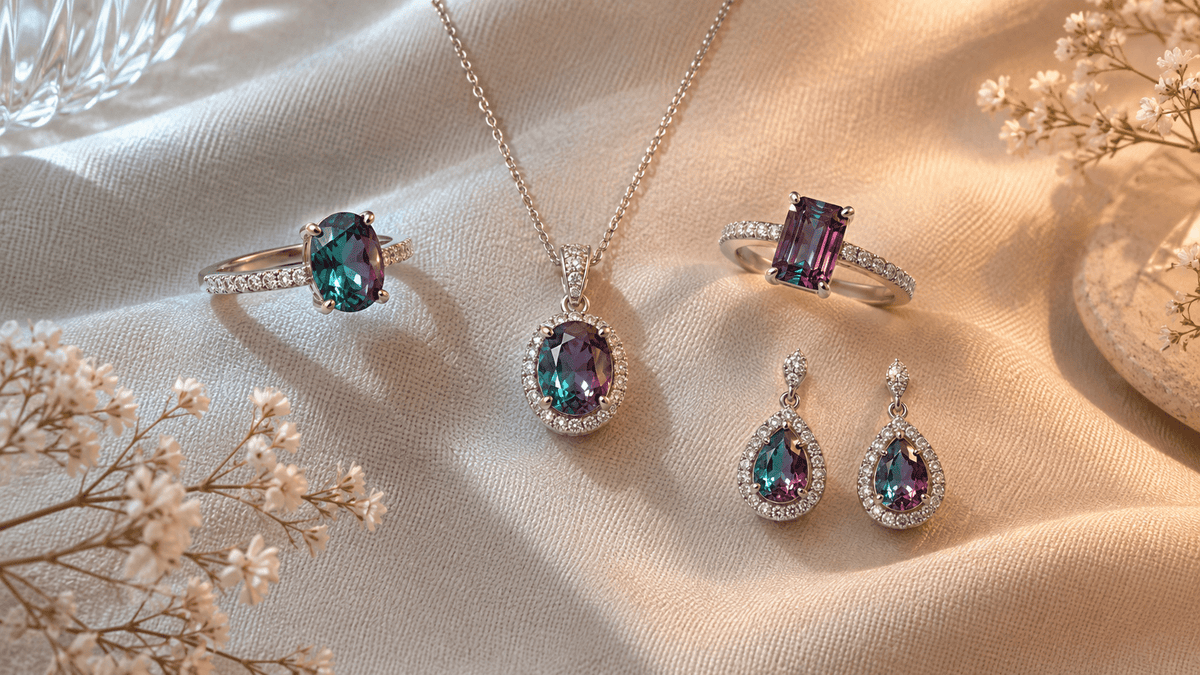
Alexandrite is a gem that seems to work magic. In daylight it glows a cool bluish green. Carry it indoors under a warm lamp or candlelight and it turns raspberry red or purple. Gem lovers describe it as "emerald by day, ruby by night," and it is one of the rarest and most fascinating stones on earth.
Discovered in Russia in the 1830s and named after a future tsar, alexandrite has a story as remarkable as its color. This guide explains what alexandrite is and how its color change works, where it comes from, the important difference between natural, lab-created and simulated alexandrite, its history and meaning, how to judge quality, how to see the color change for yourself, and how to wear and care for alexandrite jewelry.
Alexandrite is a rare color-changing variety of the mineral chrysoberyl. It looks bluish green in daylight and purplish red under warm incandescent light. It rates 8.5 on the Mohs scale, making it durable enough for everyday rings. Alexandrite is a birthstone for June and the traditional gem for the 55th wedding anniversary. Natural alexandrite is very rare and expensive, so most alexandrite in jewelry is lab-created or a simulated color-change stone.
What alexandrite is
Alexandrite is a variety of chrysoberyl, a mineral made of beryllium, aluminum and oxygen. Chrysoberyl is usually yellow, green or brown. What makes alexandrite special is a trace of chromium, the same element that gives emerald and ruby their color. In alexandrite, chromium creates a color that changes with the light.
Natural alexandrite is one of the rarest gemstones in the world. Most natural stones weigh less than one carat, and fine stones over five carats are extremely rare.

How the color change works
Alexandrite absorbs yellow light very strongly, so the light that reaches your eye is a balance between green-blue and red. Which side wins depends on the light around it:
- Daylight and cool white light are rich in blue and green, so the stone looks bluish green.
- Incandescent light and candlelight are rich in red, so the stone looks purplish red.
The finest alexandrites shift completely from a pure green to a pure red. Many stones change less dramatically, for example from teal to purple, or from greenish to pinkish. The more complete and vivid the change, the more valuable the stone.
The faces of alexandrite
Alexandrite can look very different depending on the light and the stone. These are the looks you are likely to meet:

Bluish green
Cool teal to emerald green outdoors and under cool white light.

Purplish red
Raspberry, plum or ruby red under incandescent light and candlelight.

Rare and changing
Fine needle inclusions create a band of light, like a cat's eye, that changes color too. Extremely rare.

Vivid and accessible
Real alexandrite grown in a laboratory, often with a strong, clean color change at a fraction of the price.
- Bluish green
- Emerald green
- Purple
- Raspberry
- Ruby red
Where alexandrite comes from
Alexandrite was first found in Russia, and Russian stones still set the standard for color change. Today, small amounts come from a handful of places:
| Source | Known for |
|---|---|
| Ural Mountains, Russia | The original source, discovered in the 1830s. Mines have reopened, but produce only a few carats of gem quality material a year |
| Brazil | Deposits found in 1987, some with a strong color change |
| Sri Lanka | Larger stones, sometimes with an olive green to brownish red change |
| East Africa | Tanzania and Zimbabwe, often small but well colored |
| Madagascar, Myanmar and India | Smaller deposits |
Many of the largest natural alexandrites on the market today come from antique jewelry rather than new mining.
Natural, lab-created and simulated alexandrite
This is the most important thing to know before buying alexandrite. Because natural stones are so rare and costly, most "alexandrite" in jewelry is one of the following:
| Kind | What it is | Good to know |
|---|---|---|
| Natural alexandrite | Mined color-change chrysoberyl | Extremely rare; fine stones cost thousands of dollars per carat |
| Lab-created alexandrite | Real chrysoberyl grown in a laboratory, made since the 1960s | Same chemistry and hardness as natural; strong color change; affordable |
| Simulated alexandrite | Usually lab-grown corundum or spinel with a color change | Very inexpensive; changes color but is not chrysoberyl |
| Color-change chrysoberyl | Natural chrysoberyl with a weaker change | Not always classed as alexandrite |
As a rule of thumb, a bargain-priced "alexandrite" is not natural. That does not make it less beautiful, but it should be clearly described. A reputable seller should always tell you whether a stone is natural, lab-created or simulated, and only a gem laboratory can confirm a natural alexandrite.
Alexandrite meaning and history
Alexandrite's story begins in the emerald mines of imperial Russia:
- The 1830sMiners in Russia's Ural Mountains find a green stone that turns red by firelight.
- 1834Count Lev Perovskii names the new gem after the future Tsar Alexander II. Its red and green echo the colors of imperial Russia, and it becomes a national favorite.
- The 19th centuryAlexandrite becomes a prized stone in Russian and European jewelry as Ural production declines and stones become scarce.
- By the 1950sAlexandrite is added as a June birthstone, alongside pearl and moonstone.
- From the 1960sScientists grow alexandrite in the laboratory, making its color change available to everyone.
- 1987Deposits are found in Brazil, renewing interest in natural alexandrite.
Alexandrite is associated with balance, transformation, joy and luck, and its two colors with the two sides of a person or a relationship. These meanings come from tradition rather than science, but they make alexandrite a meaningful gift for a new chapter, an anniversary or someone who brings a little magic into your life.
June birthstone and 55th anniversary gem
Alexandrite is one of three birthstones for June, alongside pearl and moonstone. It is also the traditional gem for the 55th wedding anniversary, a fitting gem for a love that has changed and deepened over a lifetime.
Alexandrite vs other color-change gems
Several gems can change color, but alexandrite is the most famous, and one of the hardest:
Color-change garnet7–7.5
Emerald7.5–8
Alexandrite8.5
Color-change sapphire9
Diamond10
Bars for gems with a range are shown at the top of the range.| Gem | Typical change | Good to know |
|---|---|---|
| Alexandrite | Bluish green to purplish red | The classic color-change gem; rare when natural |
| Color-change sapphire | Blue to purple | Natural or lab-grown; often used to simulate alexandrite |
| Color-change garnet | Green or brown to red or purple | Rare natural garnet |
Love the idea of green and red? Read our guides to emerald and ruby.
Quality and value
With alexandrite, the color change matters more than anything else:
- Strength of change. The most valuable stones show a complete, dramatic change. Stones with a weak or partial change are worth much less.
- Colors. The closer the colors are to pure green and pure red, the better. Muddy, brownish or grayish colors lower value.
- Clarity. Many natural alexandrites have inclusions. Color change matters more than clarity, and included stones are often cut as cabochons.
- Size. Prices climb steeply with size. Top natural stones average roughly $1,800 per carat under one carat and several thousand dollars per carat above it.
Lab-created alexandrite offers a vivid, clean color change for a tiny fraction of the cost of a natural stone, which is why it is so popular in everyday jewelry.
How to see the color change
Seeing alexandrite change is half the fun. A few tips:
- Start outdoors or by a window to see its daylight green.
- Then move under a warm, yellow bulb or candlelight to see it turn red or purple.
- Try different lights at home. Modern LED bulbs vary a lot. Warm white bulbs bring out the red; cool white bulbs bring out the green.
- Don't trust your phone camera alone. Cameras often struggle to capture the change accurately, so the stone in person can look quite different from photos.
Hardness, durability and care
At 8.5 on the Mohs scale, alexandrite is harder than emerald, topaz and quartz, and it is generally tough, which makes it an excellent choice for rings worn every day. Like any gem, it can be damaged by a hard knock or extreme heat.

Do
- Clean with warm water, a drop of mild soap and a soft brush
- Rinse well and dry with a soft, lint-free cloth
- Store it separately, since it can scratch softer gems
- Check prongs and accent stones every few months
Don't
- Expose it to extreme heat or sudden temperature changes
- Knock it against hard surfaces
- Use harsh chemicals on vermeil or plated settings
- Wear rings for heavy work, the gym or gardening
How to style alexandrite
Alexandrite's two personalities make it wonderfully versatile:
- Alexandrite and rose gold warms up the purple and red tones, perfect for evenings.
- Alexandrite and sterling silver brings out its cool daytime green.
- Alexandrite and yellow gold feels vintage and regal, like a Russian heirloom.
- Alexandrite with a halo of clear stones adds sparkle and frames the changing color.
- Day to night is alexandrite's superpower: one piece that looks fresh at the office and romantic at dinner.
Handmade in Virginia by artists with autism.
Shop the Alexandrite CollectionShop alexandrite jewelry by style
From vintage halo rings to everyday necklaces, these are our favorite alexandrite designs. Browse the full Alexandrite Collection for every style and metal.
Alexandrite rings. Vintage halos, starbursts and dainty designs.

Ana Alexandrite Ring
An oval alexandrite framed by an ornate vintage-style double halo of round and marquise-inspired accents. Our most glamorous alexandrite ring.
Shop the Ana ring →
Zoe Alexandrite Ring
An oval color-shifting alexandrite in a vintage-inspired starburst setting, with pear and round crystals continuing along a slim band.
Shop the Zoe ring →
Fia Alexandrite Ring
A vibrant alexandrite center with hand-selected crystals in a vintage-inspired design. Rose gold brings out the stone's evening purple.
Shop the Fia ring →
Fig Alexandrite Ring
An oval alexandrite with marquise and round crystal accents on a twisted, textured band.
Shop the Fig ring →
Ava Alexandrite Ring
An elongated marquise alexandrite with round accent stones that taper toward each end of the band. Delicate and easy to stack.
Shop the Ava ring →Necklaces and earrings. Watch the color shift as you move from day to night.

Phi Alexandrite Necklace
A handcrafted pendant with a color-changing alexandrite that shifts from teal to green to purple to red as the light changes.
Shop the Phi necklace →
Ina Alexandrite Earrings
A pear-shaped alexandrite in a halo setting with an elongated teardrop silhouette. Dramatic and perfect for evenings.
Shop the Ina earrings →
Jia Alexandrite Earrings
A round alexandrite framed by a halo of clear crystals, with butterfly backs. Classic studs with a little magic.
Shop the Jia earrings →For him. A men's band with a touch of color change.

Sam Alexandrite and Ruby Band
An 8mm polished tungsten carbide band with an alexandrite and ruby inlay and a comfort fit interior. Each ring is one of a kind.
Shop the Sam band →