
Gemstones: Billions of Years in the Making, Thousands of Years of History & Still Completely Personal
Before gemstones became engagement rings, birthstones or anniversary gifts, they were minerals growing inside the Earth.
Heat, pressure, water, minerals and enormous spans of geological time created colors and crystal structures that humans eventually uncovered, cut, polished and turned into jewelry.
For thousands of years gemstones have represented wealth, protection, love, power, religion, royalty, family, birth months, mythology and personal identity.
Today we have even more ways to wear them.
An Emerald can become an unconventional engagement ring. Moss Agate can look like a miniature forest. Alexandrite can seem to change color with the light. Opal can flash with multiple colors at once. Black Onyx can turn a familiar ring dark and dramatic. Morganite can create soft blush romance. Sapphire can remain beautifully traditional or become completely modern.
At Kherish, those differences are the point.
What exactly makes something a gemstone?
Most gemstones begin as naturally occurring minerals, although some familiar gem materials are organic or otherwise fall outside the simplest mineral definition.
Only a small portion of the minerals found on Earth become gemstones. A material generally needs some combination of beauty, color, rarity, transparency, optical interest and enough durability to be useful for decoration or jewelry.
That is why ordinary quartz can exist almost everywhere, while gem-quality quartz with beautiful clarity, color or internal features becomes something worth cutting and wearing.
Something worth looking at
Color, brilliance, transparency, pattern, inclusions or optical effects can all make a mineral visually interesting enough to become a gem.
Something that can be worn
A gemstone used in jewelry needs enough resistance to ordinary wear for the type of piece being created.
Something nature does not produce everywhere
Gem-quality material can require an unusually specific combination of geological conditions, which is part of what makes fine gemstones special.
Gemstones are products of geology.
Some form when molten material cools. Some develop inside metamorphic rocks transformed by heat and pressure. Others grow from mineral-rich fluids moving through fractures and cavities. Still others are carried toward Earth's surface by volcanic activity.
Peridot provides a particularly dramatic example. It is the gem variety of olivine, a mineral abundant in parts of Earth's mantle. Some peridot-bearing material reaches the surface inside volcanic rock.
Ruby and Sapphire belong to the corundum family, while Emerald belongs to beryl. Quartz produces an enormous family of gem materials, including Amethyst, Citrine and many varieties valued for color or inclusions.
The finished ring may be new. The geological story inside its gemstone can be unimaginably old.
That is part of the wonder of natural gemstones.
A jeweler creates the setting.
A lapidary creates the finished cut.
But nature created the material long before either of them existed.
Ancient jewelry
Early civilizations used colored stones not simply for decoration, but as objects connected to social status, religion and identity.
Egyptian treasures
Garnet jewelry was worn in ancient Egypt and examples were buried with pharaohs as valued possessions for the afterlife.
Roman signet rings
Gemstones could be carved into seals and used to stamp wax, giving a stone both decorative and practical importance.
Medieval symbolism
Colored stones continued to be associated with nobility, religion, protection and supposed mystical properties.
Royal color
Ruby, Sapphire and Emerald became especially important in fine jewelry, with extraordinary examples connected to royal and aristocratic collections.
Modern individuality
Today gemstones are no longer reserved for royalty. People choose them for engagements, birthdays, fashion, birthstones, symbolism or simply because they love the color.
For colored gemstones, color has always been one of the biggest parts of the attraction.
A gemstone does not have to imitate a colorless stone to be beautiful.
The colored-stone world gives jewelry an enormous palette: deep Ruby red, Sapphire blue, Emerald green, Morganite blush, Citrine gold, Amethyst violet, Aquamarine blue, Opal rainbow and Alexandrite's changing color.
Gemologists evaluate colored stones through several factors, but hue, tone and saturation play an enormous role in the way we perceive them.
That is also why choosing a colored engagement ring can feel so personal. Color is emotional. People already know which colors they repeatedly return to.
Red with centuries of history
Ruby is the red variety of corundum. Its saturated color has made it a symbol of passion, power and luxury across many jewelry traditions.
It is also the modern July birthstone.
Explore RubyMuch more than blue
Sapphire is also corundum. Blue is the most famous color, but sapphires can occur in other colors as well.
Its excellent durability makes it especially useful for rings and everyday jewelry.
Explore SapphireGreen that has never needed to be subtle
Emerald belongs to the beryl family and has been treasured for its saturated green color for centuries.
It remains one of the most recognizable colored gemstones in the world.
Explore Emerald| Gemstone | Known For | Kherish Style Direction |
|---|---|---|
| Alexandrite | Color-changing appearance | Fantasy, vintage and alternative engagement rings |
| Amethyst | Violet quartz | Romantic and classic gemstone jewelry |
| Aquamarine | Pale ocean-blue beryl | Soft, airy engagement jewelry |
| Black Onyx | Deep opaque black | Gothic, dramatic and high-contrast jewelry |
| Black Rutilated Quartz | Dark needle-like internal inclusions | Moody, natural and one-of-a-kind-looking centers |
| Blue Sandstone | Dark blue with star-like sparkle | Celestial and fantasy styling |
| Citrine | Warm yellow-to-golden quartz | Sunny vintage and birthstone jewelry |
| Garnet | Rich reds and a long jewelry history | Vintage, Black Gold and Gothic romance |
| London Blue Topaz | Deep saturated blue | Bold blue engagement jewelry |
| Moissanite | High brilliance | Bright alternative bridal jewelry |
| Moonstone | Soft glowing optical effect | Spiritual, dreamy and fantasy-inspired designs |
| Morganite | Blush pink beryl | Romantic engagement rings |
| Moss Agate | Green branching inclusions | Nature-inspired, woodland and fairytale jewelry |
| Opal | Color play and shifting flashes | Fantasy, bridal and statement jewelry |
| Peridot | Bright yellow-green color | Fresh, vivid and unusual color |
| Rose Quartz | Soft pink quartz | Romantic and delicate jewelry |
| Ruby | Rich red corundum | Classic and dramatic engagement jewelry |
| Sapphire | Durability and saturated color | Classic and alternative engagement rings |
| Strawberry Quartz | Pink-to-red internal color and inclusions | Soft fantasy and geometric gemstone jewelry |
| White Fire Opal | Pale body color with colorful flashes | Fairytale, bridal and celestial jewelry |
Some gemstones are beautiful because nature left visible evidence inside them.
Traditional jewelry marketing spent generations teaching customers to think that every inclusion should disappear.
But many of today's most interesting stones do exactly the opposite.
Moss Agate is loved because its green inclusions can resemble moss, branches or tiny landscapes.
Black Rutilated Quartz is valued for visible needle-like rutile. Salt-and-pepper stones make dark and light inclusions the center of the aesthetic.
These materials remind us that natural gemstones are not photocopies.
Natural variation is not automatically a flaw.
In many gemstone families, the internal pattern is exactly why the stone was chosen.

Ada Rose Gold Ring
Ada demonstrates how one design can change a unique gemstone that displays different colors depending on lighting.
That makes the center colors part of the design rather than a secondary detail.
View Ada
Agi Strawberry Quartz Ring
Soft pink Strawberry Quartz inside a geometric center shows how an unusual cut can make a gentle gemstone look contemporary rather than traditional.
View Agi
Ali Orchard Pink Opal Ring Set
Bright pink opal turns a coordinated bridal set into something playful, vivid and unmistakably different from a traditional clear center.
View Ali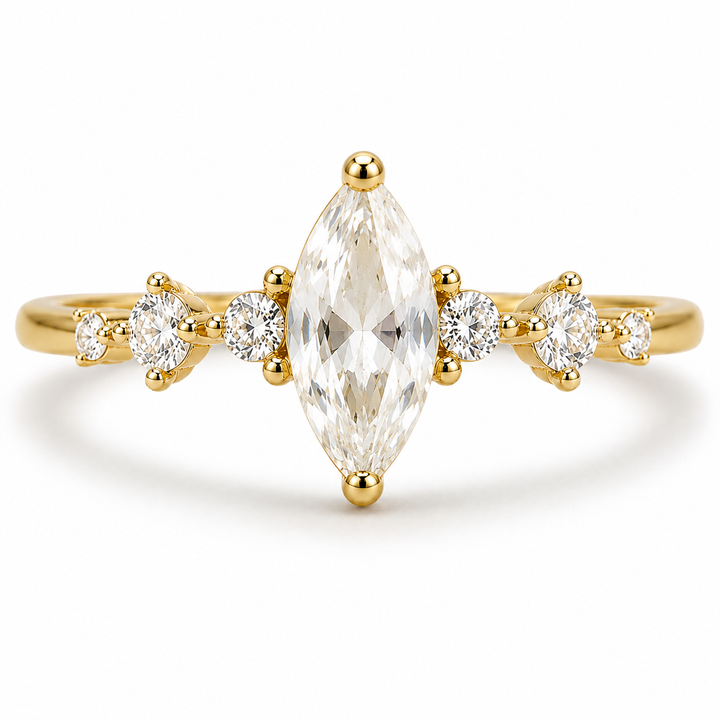
Ava Moissanite Ring
A bright marquise center gives Ava a more traditional sparkle story, while the elongated shape and delicate setting keep the overall design distinctive.
View Ava
Hansi Curved Gemstone Band
Gemstones do not have to appear only in a center ring. Hansi uses marquise and round accents to create a curved, leaf-like contour for custom stacking.
View Hansi
Explore Every Gemstone Direction
Kherish currently carries hundreds of gemstone jewelry variations across rings, bands, necklaces and earrings.
Shop by stone, metal, shape or simply find the piece that immediately looks like you.
Shop AllDifferent cultures developed different gemstone associations, and historical lists did not always agree.
The standardized American birthstone list dates to 1912, when the organization that became Jewelers of America established a modern list for the jewelry trade.
That modern system gave people one of the easiest ways to personalize jewelry without creating a custom design.
A gemstone could now say something about the wearer before any engraving was added.
| Month | Modern Birthstone | Color Direction |
|---|---|---|
| January | Garnet | Most famous in rich red |
| February | Amethyst | Purple |
| March | Aquamarine | Pale blue |
| April | Diamond | Traditionally colorless |
| May | Emerald | Green |
| June | Pearl, Moonstone, Alexandrite | Multiple possibilities |
| July | Ruby | Red |
| August | Peridot, Spinel, Sardonyx | Peridot is vivid yellow-green |
| September | Sapphire | Most famous in blue |
| October | Opal, Tourmaline | Wide color range |
| November | Topaz, Citrine | Often warm yellow-to-golden tones |
| December | Turquoise, Tanzanite, Zircon | Strong blue traditions |
Why people still give stones meanings even when they do not believe in crystal healing
Gemstone symbolism is much older than modern crystal culture.
For centuries people connected stones with protection, love, courage, royalty, luck, health, religion and the supernatural.
Modern spiritual traditions continue many of those ideas, although spiritual claims should be understood as cultural or metaphysical beliefs rather than scientifically demonstrated medical effects.
A person also does not need to believe a stone has supernatural power for its symbolism to matter.
A Garnet can represent endurance because someone wore it through a difficult year. An Emerald can represent a May birthday. Moss Agate may represent a love of forests. Alexandrite may be chosen because change itself feels meaningful.
Personal meaning can be just as powerful as inherited tradition.
| Gemstone | Common Traditional or Modern Symbolism |
|---|---|
| Alexandrite | Change, transformation, balance and good fortune |
| Amethyst | Clarity, calm, protection and spiritual awareness |
| Aquamarine | Calm, travel, the sea and clear communication |
| Black Onyx | Protection, grounding, boundaries and strength |
| Citrine | Warmth, optimism, prosperity and creativity |
| Emerald | Love, rebirth, growth and renewal |
| Garnet | Protection, passion, loyalty and endurance |
| Moonstone | Intuition, cycles, new beginnings and feminine symbolism |
| Morganite | Love, tenderness and emotional connection |
| Moss Agate | Nature, growth, grounding and abundance |
| Opal | Creativity, imagination and individuality |
| Peridot | Renewal, positivity and growth |
| Rose Quartz | Love, compassion and gentleness |
| Ruby | Passion, vitality, courage and love |
| Sapphire | Wisdom, loyalty, truth and commitment |
Formed by nature
A natural gemstone formed through geological processes rather than being grown by humans.
Natural stones can still be cut, polished and in some cases treated after mining.
Same gemstone material, human-grown
A laboratory-created gem has essentially the same chemical, physical and optical properties as its natural counterpart, but crystal growth occurs in a controlled environment.
Looks similar, different material
A simulant resembles another gemstone visually but is not the same gem material.
Accurate material descriptions matter because these categories should never be treated as interchangeable.
Treatment is part of gemstone history too.
Humans have altered the appearance of gemstones for centuries.
Heating, oiling, dyeing, irradiation and other processes can improve color, clarity or appearance depending on the material.
Treatment does not automatically make a gemstone bad. What matters is accurate representation and understanding the material you are buying.
Different stones also have different treatment traditions. Emerald, Sapphire, Ruby, Topaz and Chalcedony, for example, do not share one universal treatment story.
| Cut | Visual Personality | Why People Choose It |
|---|---|---|
| Round | Balanced, classic | Maximum familiarity and symmetry |
| Oval | Soft and elongated | Classic with more finger coverage |
| Pear | Romantic and directional | Traditional teardrop with a distinctive point |
| Marquise | Long and dramatic | Strong elongation and vintage associations |
| Emerald Cut | Linear and architectural | Clean geometry and broad flashes of light |
| Kite | Sharp and alternative | Fantasy and modern geometric styling |
| Hexagon | Balanced geometry | Six-sided architecture without losing symmetry |
| Coffin | Gothic and unconventional | An unmistakably alternative center shape |
| Cushion | Soft vintage geometry | Combines rounded corners with a structured outline |
| Princess | Crisp and square | Modern straight edges and strong symmetry |
The Mohs hardness scale measures resistance to scratching.
That is important, but it is not the entire durability story. Gemologists also consider toughness and stability.
A very hard gemstone can still fracture under a strong impact, and a softer gemstone can remain beautiful for years when worn and cared for appropriately.
This is particularly important for rings because hands encounter far more impact than earrings or necklaces.
| Gemstone | Approx. Mohs Hardness | Wear Note |
|---|---|---|
| Sapphire / Ruby | 9 | Excellent scratch resistance for frequent ring wear |
| Alexandrite | 8.5 | Very suitable for jewelry with ordinary care |
| Topaz | 8 | Hard but should still be protected from strong blows |
| Emerald / Morganite / Aquamarine | 7.5–8 | Good jewelry stones, though individual toughness differs |
| Quartz Family | About 7 | Includes Amethyst, Citrine and many quartz varieties |
| Black Onyx | About 6.5–7 | Suitable with reasonable protection from scratches and impact |
| Peridot | About 6.5–7 | Wear with more care than Sapphire or Ruby |
| Moonstone | About 6–6.5 | Best protected from hard impact and abrasive wear |
| Opal | About 5–6.5 | Requires gentler care, especially in rings |
There is no single cleaning method that is perfect for every stone.
Different gemstones respond differently to heat, chemicals, vibration and moisture.
That means a cleaning method that is safe for Sapphire should not automatically be assumed safe for Opal, Emerald or Moonstone.
Use gentle cleaning
For many gemstone pieces, lukewarm water, mild soap and a soft cloth or very soft brush are the safest starting point.
Take rings off for heavy work
Weightlifting, gardening, moving furniture, construction work and similar activities can strike stones and bend settings.
Separate harder and softer stones
A Sapphire can scratch softer gemstones in a jewelry box, so separate storage is often the safest approach.
Jewelry does not need to join your cleaning routine
Remove jewelry before household cleaners, chlorine and other harsh chemicals whenever possible.
Do not assume it is safe
Some stones and treatments should not be placed in ultrasonic cleaners. Check the care requirements of the specific gemstone first.
Check prongs and settings
A beautiful gemstone still depends on the metal around it remaining secure.
An engagement ring is already symbolic. That makes it a natural place for a meaningful gemstone.
Sapphire offers outstanding durability and centuries of fine-jewelry history.
Emerald creates saturated green. Ruby offers deep red. Alexandrite changes with the light. Morganite creates soft blush color. Moss Agate gives every center a different natural pattern. Opal brings visible color play. Black Onyx rejects the traditional bright bridal palette entirely.
There is no single gemstone personality because there is no single kind of person getting engaged.
Sometimes “different” simply means more accurate to the person wearing it.
They already know their favorite color
Someone who has loved green their entire life may feel far more connected to Emerald or Moss Agate than to a colorless center.
The stone can carry a story
Birthstones, spiritual associations, family traditions and shared memories can make the gemstone itself meaningful.
Not every ring needs to look the same
Alternative gemstones make it much easier to build a ring around personality rather than convention.
| Metal | Effect on Gemstones |
|---|---|
| Sterling Silver | Cool, bright and high contrast. Especially crisp with Sapphire, Emerald, Black Onyx, Alexandrite and blue stones. |
| Yellow Gold | Warm, traditional and rich. Beautiful with Emerald, Ruby, Garnet, Citrine and vintage-inspired designs. |
| Rose Gold | Soft and romantic. Especially flattering with Morganite, Rose Quartz, Alexandrite, Black Onyx and green stones. |
| Black Gold | Dark and dramatic. Creates particularly strong contrast with Garnet, Opal, Ruby and bright accent stones. |
| White Gold | Clean precious-metal appearance that keeps attention on gemstone color rather than adding warmth. |
The current collection includes large assortments of White Fire Opal, Emerald, Moss Agate, Sapphire, Morganite, Alexandrite, London Blue Topaz, Black Onyx, Ruby, Garnet, Blue Sandstone and more.
That variety matters because choosing a gemstone is often easier when customers can compare very different personalities side by side.
Someone who begins looking for a traditional Sapphire may discover Moss Agate.
Someone who expected Emerald may fall in love with Black Rutilated Quartz.
Someone who thought they wanted a pale center may discover that Black Onyx feels far more like them.
The purpose of variety is not to make the choice harder. It is to make it more likely that one option feels exactly right.
A beautiful design is only useful if the person it was made for can actually wear it.
Kherish's current All Products collection includes an unusually broad range of ring sizes.
Current collection filtering begins below size 3 on selected designs and extends through size 16.25 on selected rings and bands.
The collection also includes extensive quarter-size options.
That means customers do not have to choose between an unusual gemstone and an appropriate fit.
Gemstone inclusivity should come with size inclusivity. An Emerald, Opal, Sapphire, Moss Agate or Alexandrite design should not suddenly stop being available because someone's finger falls outside a narrow traditional size range.
A gemstone can pass through miners, sorters, cutters, polishers, suppliers and jewelers before reaching a customer.
That is why responsible sourcing involves more than looking at the finished stone.
Kherish selects suppliers using ethical factors including fair and livable wages, worker safety, employee treatment, responsible sourcing practices, stone quality and a proven track record.
We refuse to knowingly work with suppliers using slave labor, forced labor, abusive tactics or dangerous labor practices.
Beautiful jewelry should not require someone else to absorb an unacceptable human cost.
You do not need to begin with gemology. Begin with yourself.
| Ask Yourself | Why It Helps |
|---|---|
| What color do I always wear? | Your existing wardrobe often tells you more about the right gemstone than a trend report ever could. |
| Is this an everyday ring? | Durability becomes more important for jewelry worn constantly on the hand. |
| Do I like perfect clarity or visible natural character? | This can separate traditional clear gems from Moss Agate, Rutilated Quartz and Salt-and-Pepper styles. |
| Do I want classic or unusual? | Sapphire and Emerald can feel traditional, while Hexagon Moss Agate, Black Onyx or Coffin Cut centers push farther away from convention. |
| Does birthstone meaning matter? | A birth month can immediately narrow the gemstone family. |
| Does symbolism matter? | Historical and personal meanings can make one stone feel more emotionally relevant. |
| What metal do I prefer? | The metal changes how the same gemstone color appears on the hand. |
The questions behind the sparkle
What is a gemstone?
A gemstone is a material valued for qualities such as beauty, color, rarity, optical character and suitability for ornamental use. Many gemstones are minerals, although not every gem material fits the strict mineral definition.
How do natural gemstones form?
Different gemstones form through different geological processes, including crystallization from molten material, metamorphism under heat and pressure, growth from mineral-rich fluids and other processes inside Earth.
How old can a natural gemstone be?
The geological processes that create gemstones can be hundreds of millions of years old or more. The exact age depends on the deposit and material.
Why have humans worn gemstones for so long?
Gemstones have historically represented beauty, wealth, social status, religion, protection, symbolism, political power and personal identity.
What are the three best-known precious colored gemstones?
Ruby, Sapphire and Emerald are traditionally the most important colored gemstones in the modern fine-jewelry market.
What is a birthstone?
A birthstone is a gemstone associated with a particular month. The modern American list was standardized in 1912 by the organization that became Jewelers of America.
Are birthstone lists ancient?
Gemstone symbolism is ancient, but the standardized modern American twelve-month birthstone list is much newer. Older traditions varied considerably.
What is the June birthstone?
The modern list includes Pearl, Moonstone and Alexandrite for June.
What is the July birthstone?
Ruby is the modern July birthstone.
What is the September birthstone?
Sapphire is the modern September birthstone.
What is the October birthstone?
Opal and Tourmaline are the modern October birthstones.
Are natural inclusions bad?
Not automatically. In some stones clarity is highly prized, while in gemstones such as Moss Agate, Rutilated Quartz and Salt-and-Pepper styles, visible inclusions are an intentional part of the aesthetic.
Are all natural gemstones identical?
No. Color, internal pattern, inclusions and other natural characteristics can vary from one stone to another.
What is the difference between natural and lab-created gemstones?
Natural gemstones formed through geological processes. Lab-created gemstones are grown in controlled environments but can share essentially the same chemical, physical and optical properties as their natural counterparts.
What is a gemstone simulant?
A simulant resembles another gemstone visually but is a different material. It should not be confused with a laboratory-created version of the actual gemstone.
Are treated gemstones real gemstones?
Treatment does not automatically make a gemstone an imitation. Many natural gemstones are routinely treated to alter or improve color or clarity. Accurate disclosure of the material and treatment is what matters.
What does Mohs hardness mean?
Mohs hardness measures resistance to scratching. It is useful when comparing gemstones, but it does not measure every aspect of durability.
What gemstones are good for everyday rings?
Sapphire and Ruby are particularly durable options. Other gemstones can also work beautifully in rings, but the appropriate level of care depends on the specific material.
Can Opal be used in an engagement ring?
Yes, but Opal is softer than Sapphire or Ruby and requires more thoughtful everyday care.
Why is Moss Agate so popular?
Moss Agate contains natural green inclusions that can resemble moss, branches and miniature landscapes, making each center visually individual.
Why is Alexandrite unusual?
Alexandrite is known for appearing different colors under different lighting conditions, which gives it a uniquely changeable visual character.
Why do people choose Black Onyx?
Black Onyx offers deep opaque contrast rather than traditional bright gemstone color and works particularly well in Gothic, vintage and alternative jewelry.
Why do people choose colored engagement rings?
Colored gemstones allow an engagement ring to reflect favorite colors, birthstones, symbolism, personal taste and a style outside the conventional clear-center look.
Does gemstone cut matter?
Yes. The shape and faceting of a stone change its proportions, light performance and overall style. A pear, hexagon, marquise and coffin cut can make the same gemstone family look completely different.
What gemstone looks best in Sterling Silver?
There is no single correct answer. Sterling Silver creates especially crisp contrast with Emerald, Sapphire, Alexandrite, Black Onyx, London Blue Topaz, Opal and many other colored stones.
What gemstone looks best in Rose Gold?
Rose Gold works beautifully with Morganite, Rose Quartz, Alexandrite, Black Onyx, Moss Agate and many green or violet stones.
How should gemstone jewelry be cleaned?
Care depends on the gemstone. Gentle soap, lukewarm water and a soft cloth are useful for many materials, but ultrasonic and steam cleaning are not appropriate for every gemstone.
Should gemstone jewelry be removed during exercise?
Rings should generally be removed during weightlifting, heavy exercise, manual work and activities where the setting or gemstone could receive strong impact.
What gemstones does Kherish currently carry?
The current collection includes Alexandrite, Amethyst, Aquamarine, Black Onyx, Black Opal, Black Rutilated Quartz, Blue Opal, Blue Sandstone, Citrine, Emerald, Garnet, Jade, Lilac Quartz, London Blue Topaz, Moissanite, Moonstone, Morganite, Moss Agate, Peridot, multiple Opals, Rose Quartz, Ruby, Sapphire, Strawberry Quartz, Topaz and additional gemstone and natural-material options.
Does Kherish offer extended ring sizing?
Yes. Current collection filters include extensive standard, half and quarter sizing and selected designs extending through size 16.25. Exact availability varies by individual ring.
Long before it became jewelry, your stone already had a history.
Ruby traveled through ancient trade routes. Garnet was buried with Egyptian pharaohs. Sapphire became a symbol of loyalty. Emerald became synonymous with extraordinary green. Opal turned light itself into color.
And modern jewelry has expanded the story even further.
Moss Agate gives us tiny forests. Rutilated Quartz celebrates inclusions. Alexandrite changes with the light. Black Onyx makes darkness elegant. Morganite turns blush into bridal jewelry. Blue Sandstone looks like midnight filled with stars.
Choose a gemstone because it is your birthstone. Choose it because of its history. Choose it because of its symbolism. Choose it because it reminds you of someone.
Or forget every rule and choose the stone you cannot stop looking at.
Explore All Kherish Gemstone JewelryRelated Posts

Kherish will create a custom design around you - Custom Rings

The Zoe Ring - A Tiny Constellation of the Stars

Black wedding rings have moved far beyond the plain dark band.

New Arrivals - A collection built around individuality.

Our Mia Collection - our favorite recognizable design interpreted through color.

June Birthstone. Ancient Moon Legend. A Glow That Are Always Unique


