
How to Find Your Ring Size at Home: Measure Once, Wear Comfortably
The most beautiful ring in the world is still frustrating if it does not fit.
A ring should feel secure enough that you are not worried about losing it, comfortable enough that you are not thinking about it all day, and easy enough to remove without turning the experience into a wrestling match.
The good news is that finding your ring size at home is much easier than most people expect.
You can measure a ring you already own, measure the finger itself, or use a properly scaled printable ring guide.
The important part is not rushing the measurement. Finger size changes with temperature, time of day, band width, knuckle size, and even which hand you are measuring.

A properly fitting ring should normally slide over the knuckle with a small amount of resistance, then sit comfortably at the base of the finger.
A ring that is too loose may rotate, shift constantly, or slip off without you noticing.
A ring that is too tight can become uncomfortable, leave excessive pressure marks, or become difficult to remove when your hands are warm or swollen.
The correct fit sits between those two extremes.
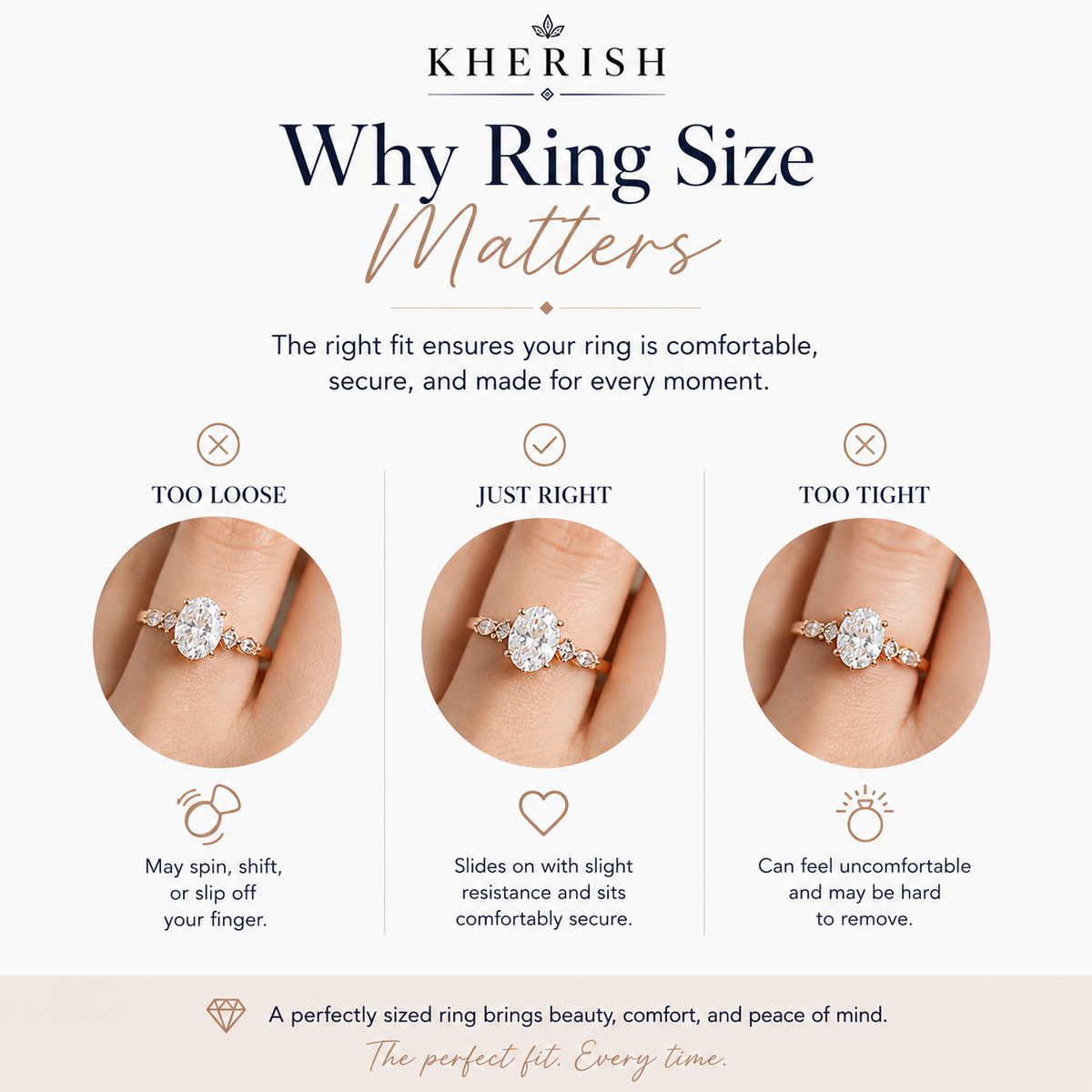
Choose the method that makes sense for what you already have.
If you own a ring that already fits the correct finger, measuring that ring can be especially convenient.
If you do not, you can measure the finger itself.
And if you prefer a visual comparison, a correctly printed sizing guide can make the process easier.
Measure a Ring You Already Own
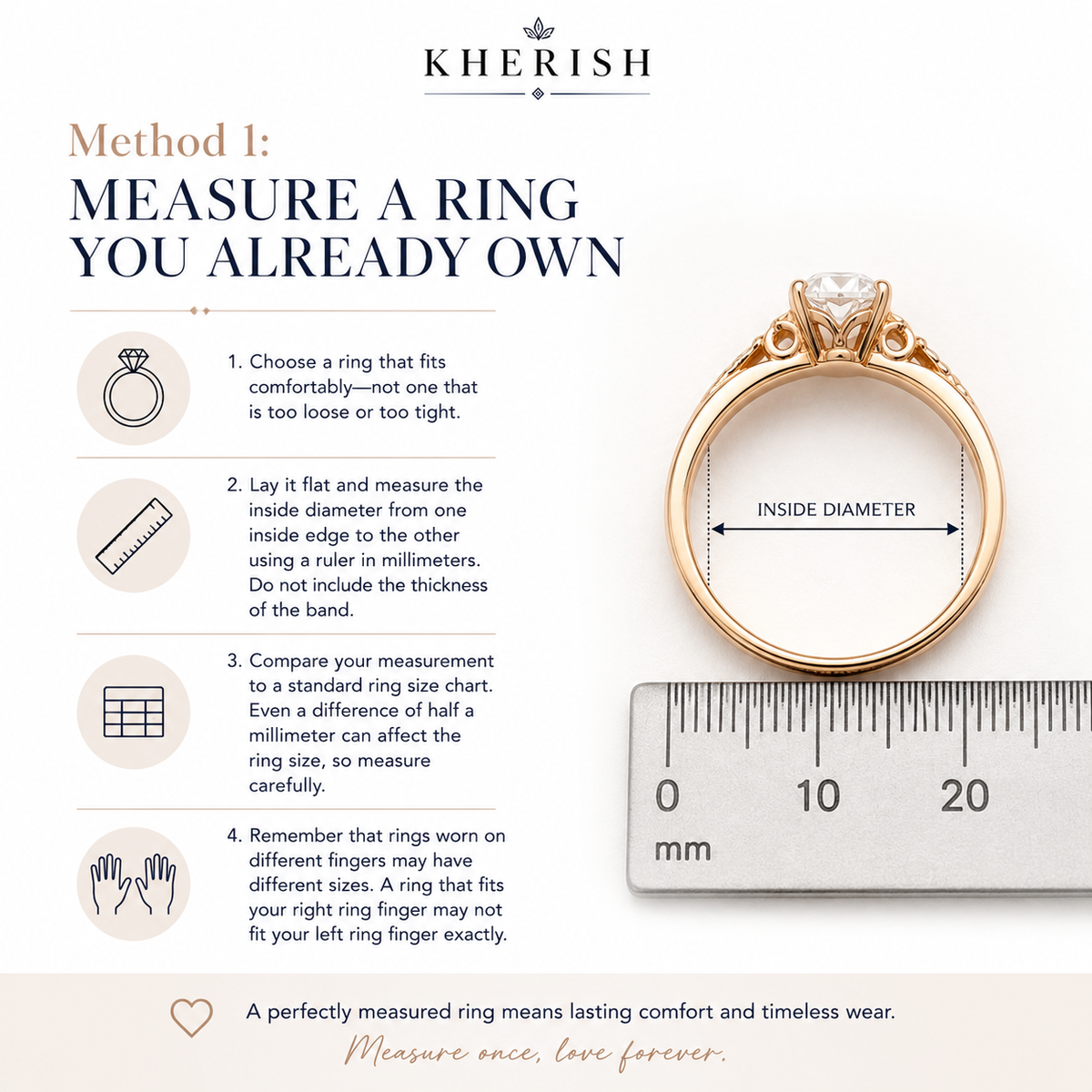
Measure the inside diameter of a comfortable ring in millimeters, then compare that diameter with a ring-size chart.
Measure Your Finger
Wrap a strip of paper or non-stretch string around the finger, mark the meeting point, then measure the circumference in millimeters.
Use a Printable Guide
Print the guide at exactly 100% scale, verify its reference measurement, then use the circles or measuring strip to determine your fit.
Choose a ring that feels genuinely comfortable.
Do not use one that spins constantly, slides off easily, or already feels too tight.
Place it flat and measure straight across the inside of the ring from one inner edge to the opposite inner edge.
Use millimeters.
Do not include the thickness of the metal itself. You are measuring the empty interior opening.
Then compare the measurement with the inside-diameter column of a ring-size chart.
Important:
Measure a ring worn on the same finger you are shopping for. Your right ring finger and left ring finger are not guaranteed to be the same size.
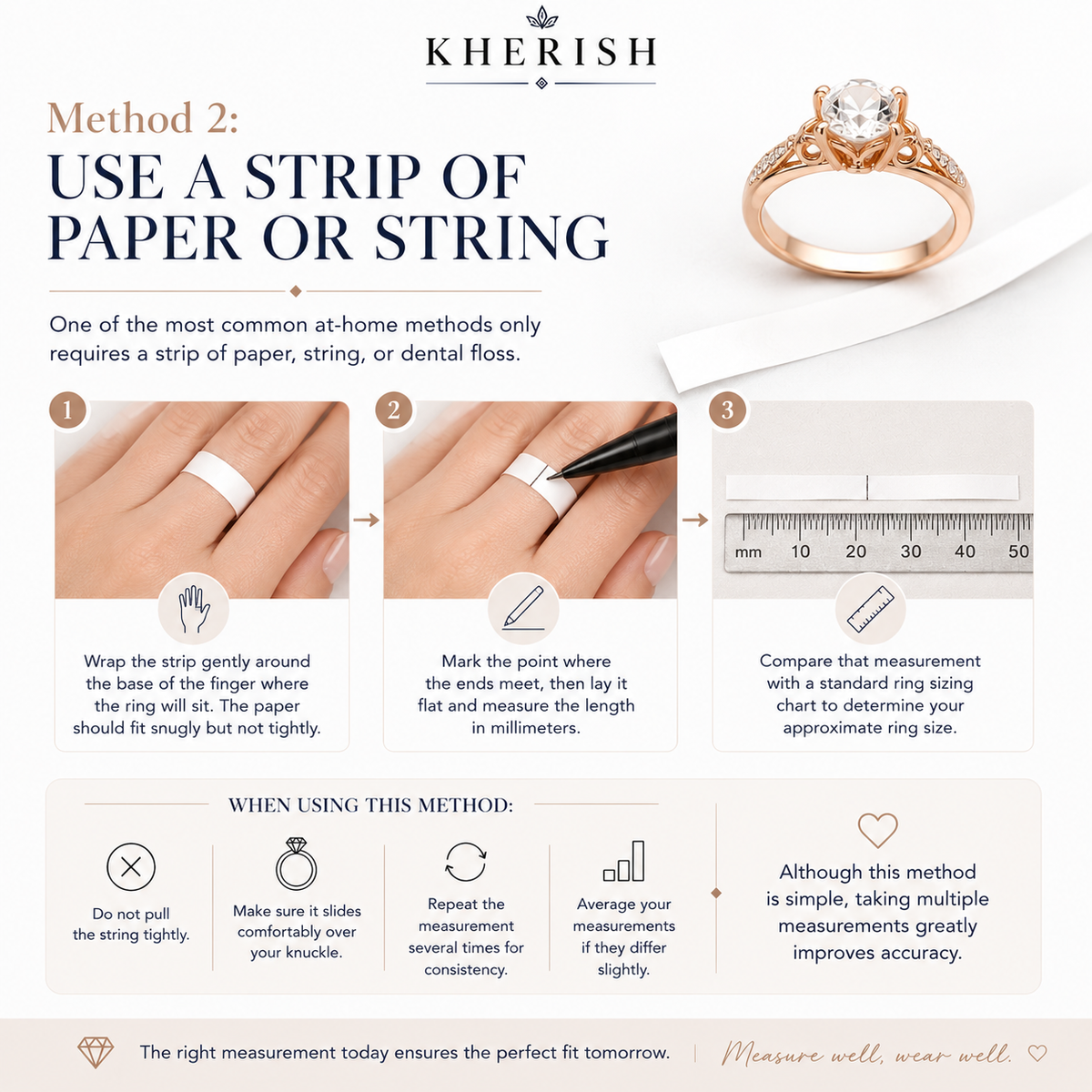
Cut a narrow strip of paper, or use a piece of non-stretch string or dental floss.
Wrap it around the base of the finger where the ring will normally sit.
It should be snug, but it should not dig into the skin.
Mark the exact point where the two ends meet.
Lay the strip flat and measure from the beginning of the strip to your mark in millimeters.
That measurement is the approximate circumference of your finger.
Compare it with the circumference column on the ring-size chart.
Do this more than once.
Paper can shift. String can move. A tiny marking difference can change the measurement. Repeat the process several times and look for consistency.
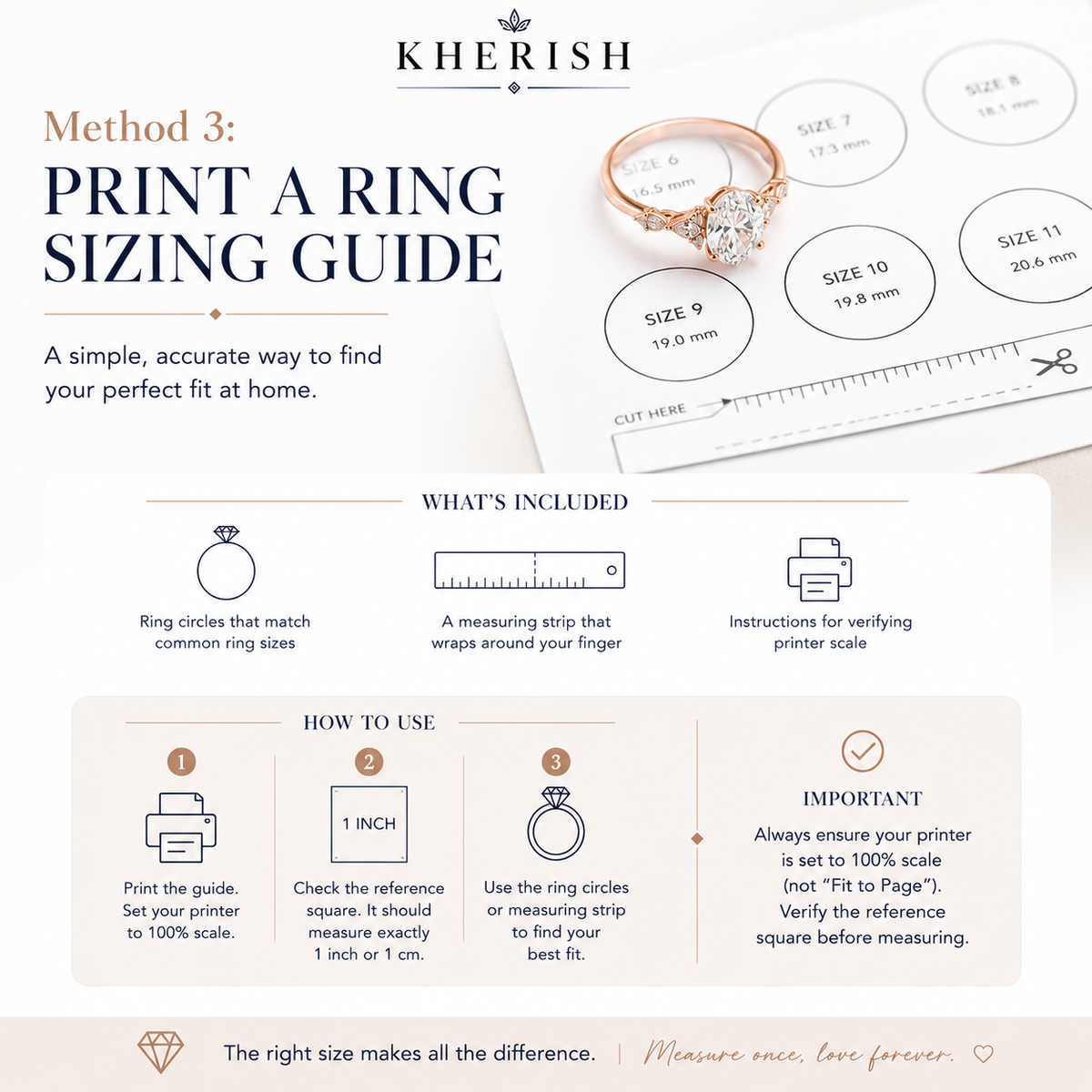
Printable ring guides generally include circles for comparing an existing ring, a measuring strip for the finger, or both.
The most important step happens before you measure anything: make sure your printer is set to 100% or actual size.
Do not use “Fit to Page.”
A guide printed even slightly larger or smaller than intended can give you the wrong ring size.
Always check the guide's reference box or scale marker before using the ring circles.
Hands can expand and contract naturally throughout the day.
Warm temperatures can make fingers larger. Cold temperatures can make them smaller. Exercise can temporarily increase swelling. Your hands may also feel different first thing in the morning than they do later in the day.
For a more useful everyday measurement, measure when your hands are at a normal comfortable temperature, and repeat the measurement at different times.
The existing Kherish guide recommends measuring in the evening, when fingers are often slightly larger, rather than relying on a measurement taken while your hands are cold. :contentReference[oaicite:1]{index=1}
The ring has to get to the base of your finger first.
Some people have a relatively straight finger profile. Others have a knuckle that is noticeably wider than the base of the finger.
If your knuckle is larger, measuring only the narrowest part of the finger can create a ring that technically matches your finger circumference but cannot comfortably pass over the knuckle.
The goal is a compromise: large enough to move over the knuckle, but secure enough that it does not spin excessively once in place.
If the knuckle and finger base differ significantly:
Take both measurements and consider the ring style. A slightly larger fit may be more practical than a ring that becomes difficult to remove.
A delicate 2mm ring touches a relatively small area of the finger.
An 8mm or 10mm wedding band covers considerably more skin.
That additional width can make a wider ring feel tighter even when both pieces technically use the same numerical size.
That is why people buying wide wedding bands often consider going approximately half a size larger.
The Kherish sizing guide specifically notes that wider bands, including many men's wedding bands, can fit more snugly and may be more comfortable when sized slightly larger. :contentReference[oaicite:2]{index=2}
| Band Style | General Fit Consideration |
|---|---|
| Very Thin / Delicate | Often feels more forgiving because less of the finger is covered. |
| Traditional Engagement Ring | Usually works close to the measured size unless the design has an unusually wide shank. |
| Stacked Rings | Several rings worn together effectively create a wider combined band and may feel tighter than one ring alone. |
| 4mm Band | A balanced middle width that generally feels less bulky than traditional broad men's bands. |
| 6–8mm Band | Covers more finger surface and may feel more snug than a narrow ring in the same numerical size. |
| 10mm+ Band | Extra width can significantly change comfort, making careful measurement especially important. |
Do not assume matching fingers on opposite hands are the same size.
Your left ring finger, right ring finger, middle finger, index finger, and thumb can all measure differently.
Even the same finger on opposite hands can differ.
The dominant hand is often slightly larger, so a ring that fits one hand beautifully may feel tighter when moved to the other.
Always measure the exact finger where the new ring will be worn.
Measure today.
Take your first measurement when your hands are at a normal, comfortable temperature.
Measure again later.
Repeat the measurement in the evening or on another day to see whether the result stays consistent.
Look for the pattern.
If several measurements repeatedly point to the same size, you can order with much more confidence.
Most bad measurements come from a few very ordinary errors.
| Mistake | Why It Causes Trouble | Better Approach |
|---|---|---|
| Pulling String Too Tight | Compresses the finger and produces an artificially small circumference. | Keep the measuring material snug but comfortable. |
| Measuring Cold Hands | Cold fingers can temporarily shrink. | Wait until your hands return to a normal temperature. |
| Ignoring the Knuckle | The ring may fit the finger base but fail to slide over the knuckle. | Check both the base and knuckle. |
| Using Stretchy String | Elastic material changes length while measuring. | Use paper or non-stretch string. |
| Measuring Only Once | Finger size naturally fluctuates. | Repeat measurements over more than one time of day. |
| Measuring the Wrong Finger | Different fingers and opposite hands can have different sizes. | Measure the exact finger where the ring will be worn. |
| Ignoring Band Width | A broad band may feel tighter than a narrow ring in the same numerical size. | Consider the width of the actual ring you intend to order. |
| Printing at the Wrong Scale | A resized printable chart makes every circle inaccurate. | Print at 100% and verify the reference measurement first. |
| US Size | Inside Diameter | Inside Circumference |
|---|---|---|
| 3 | 14.1 mm | 44.2 mm |
| 3.5 | 14.5 mm | 45.5 mm |
| 4 | 14.9 mm | 46.8 mm |
| 4.5 | 15.3 mm | 48.0 mm |
| 5 | 15.7 mm | 49.3 mm |
| 5.5 | 16.1 mm | 50.6 mm |
| 6 | 16.5 mm | 51.8 mm |
| 6.5 | 16.9 mm | 53.1 mm |
| 7 | 17.3 mm | 54.4 mm |
| 7.5 | 17.7 mm | 55.7 mm |
| 8 | 18.1 mm | 57.0 mm |
| 8.5 | 18.5 mm | 58.3 mm |
| 9 | 18.9 mm | 59.5 mm |
| 9.5 | 19.4 mm | 61.0 mm |
| 10 | 19.8 mm | 62.3 mm |
| 10.5 | 20.2 mm | 63.5 mm |
| 11 | 20.6 mm | 64.8 mm |
| 11.5 | 21.0 mm | 66.0 mm |
| 12 | 21.4 mm | 67.2 mm |
For extended sizes beyond this quick table, use the individual Kherish product listing or sizing guide. Kherish currently carries selected rings and bands well beyond a size 12, with some collections reaching into the mid-teen sizes.
US, UK, Australian, European and Japanese sizing systems do not use the same labels.
A US size 7 is not called “7” in every country.
That is why international shoppers should convert the measurement itself, not simply assume the same number applies.
Kherish primarily uses US sizing on product listings, so if you already know your size under another system, convert it before selecting the product option.
| US | UK / Australia | Europe | Japan |
|---|---|---|---|
| 4 | H | 46.5 | 7 |
| 5 | J 1/2 | 49 | 9 |
| 6 | L | 51.5 | 12 |
| 7 | N | 54 | 14 |
| 8 | P | 57 | 16 |
| 9 | R | 59.5 | 18 |
| 10 | T 1/2 | 62 | 20 |
| 11 | V 1/2 | 65 | 23 |
| 12 | Y | 67 | 25 |
This is especially worth remembering if you are buying an engagement ring and one or two curved wedding bands.
Each individual band may be relatively delicate, but once several rings sit together, the total width against the finger increases.
That can slightly change the comfort of the final stack.
If you plan to wear several rings together every day, consider the finished combined width rather than judging only the engagement ring by itself.
How do you find someone's size without asking them?
Surprise proposals and gifts make ring sizing harder, but there are still better options than guessing blindly.
Use one from the correct finger.
Measure the inside diameter of a ring you know they already wear comfortably on the intended finger.
A friend or family member may know.
Someone close to the recipient may already know their size or may be able to find out more naturally.
Finger size is not visually predictable.
Hand size, height, body size, and appearance do not provide a reliable numerical ring size. Measure whenever possible.
Consider professional sizing when you are ordering a significant investment, your at-home measurements repeatedly disagree, your knuckle is substantially larger than your finger base, or you are choosing an especially wide band.
It is also useful if you have never worn rings before and do not yet know what a comfortable fit feels like.
A professional sizing does not make the at-home methods useless. It simply gives you another level of confidence when precision matters most.
Secure enough to stay. Comfortable enough to forget about.
Slight Resistance
The ring should generally require a little resistance to move over the knuckle rather than falling straight over it.
Comfortably Secure
Once in place, it should sit securely without painfully compressing the finger.
Possible Without a Struggle
A ring can require a gentle twist over the knuckle, but removal should not normally become painful or frightening.
Everything to know before choosing your size
What is the easiest way to find my ring size at home?
If you already own a ring that fits the intended finger well, measuring its inside diameter in millimeters is often one of the easiest methods. Otherwise, measure the finger circumference with paper or non-stretch string.
Should I measure in inches or millimeters?
Millimeters are preferable because ring-size differences are small and metric measurements make those differences easier to compare accurately.
When is the best time to measure my finger?
Measure when your hands are at a normal comfortable temperature. The Kherish guide recommends measuring in the evening, when fingers are often slightly larger.
Should I measure my finger when it is cold?
No. Cold fingers can temporarily shrink and may result in a ring that feels too tight later.
Should I measure after exercising?
It is better to wait until your hands return to their normal condition, because exercise can temporarily change finger size.
Why should I measure more than once?
Finger size changes during the day, and small measuring errors can also happen. Several consistent measurements are more reliable than one result.
Are my left and right ring fingers the same size?
Not necessarily. Opposite hands can measure differently, and the dominant hand is often slightly larger. Always measure the exact finger where the ring will be worn.
What if my knuckle is larger than the base of my finger?
The ring needs to pass over the knuckle while still sitting securely once it reaches the base. Measure both areas and consider the style and width of the ring.
What if I am between two ring sizes?
Band width matters. A wider band will generally feel more snug, so sizing slightly larger may be more comfortable. With a very narrow band, a closer fit may work better.
Do wide bands fit tighter?
They often feel tighter because more of the finger is covered. Many people consider going approximately half a size larger for broad bands.
Does a 4mm band fit differently from an 8mm band?
Yes. An 8mm band covers approximately twice as much width on the finger, so it can feel more snug even when the numerical ring size is the same.
Do ring stacks fit tighter?
They can. Several rings worn together effectively create a wider combined band, which may feel more snug than one ring alone.
Can I use string to measure my ring size?
Yes, but use non-stretch string and do not pull it tightly. Paper is often easier because it does not compress or stretch as readily.
Can I use dental floss?
Yes, as long as it is wrapped naturally rather than pulled tightly around the finger.
Why is stretchy string a bad idea?
Elastic material changes length while you measure, which can make the resulting circumference inaccurate.
How do I measure a ring I already own?
Measure straight across the empty inside opening from one inner edge to the opposite inner edge. Do not include the thickness of the metal.
Can I measure any ring I own?
Use a ring that fits the same finger where the new ring will be worn. A ring from another finger may not give the correct size.
How do I use a printable ring sizer?
Print at 100% or actual size, never “Fit to Page.” Verify the printed reference measurement before comparing your ring or using the measuring strip.
Does Kherish use US ring sizes?
Yes. Kherish product listings primarily use US sizing, so international customers should convert their local size before ordering.
Are UK and US ring sizes the same?
No. The UK and Australia commonly use letter-based sizing, while Kherish primarily lists numerical US sizes.
Are European and US ring sizes the same?
No. European sizing commonly corresponds more closely to circumference measurements, while US sizing uses a separate numerical scale.
How can I secretly find someone's ring size?
Measure a ring they already wear comfortably on the intended finger, or ask someone close to them who may know. Avoid trying to estimate a ring size simply from their appearance.
Can ring size be guessed from height or body size?
No. Those characteristics do not provide a dependable numerical ring size. Actual measurement is much more reliable.
Should an engagement ring spin?
A small amount of movement can occur, particularly with a top-heavy center, but constant excessive spinning may indicate that the ring is too loose or that the design requires a different fit solution.
Should a ring leave a mark on my finger?
A mild temporary impression can happen, but the ring should not painfully compress the finger or cause persistent discomfort.
When should I get professionally sized?
Professional sizing is especially useful when home measurements disagree, the ring is a significant purchase, the band is unusually wide, or your knuckle and finger base differ substantially.
Why does accurate sizing matter before ordering?
Not every ring design or material can be resized easily, so choosing the best size before production or shipment helps avoid unnecessary fit problems later.
Measure carefully now so you can stop thinking about size once the ring is on your hand.
Measure the correct finger.
Measure more than once.
Do not measure while your hands are freezing cold.
Remember the knuckle.
Consider the width of the band.
And if the measurements still do not make sense, professional sizing is worth it.
A ring should be something you notice because it is beautiful, not because you spend all day worrying that it will fall off or wondering how you are going to get it off your finger.
Find Your Kherish Ring Size``` I used the current Kherish sizing page itself as the source for the article. It currently explains the same three measuring methods, recommends measuring the exact intended finger more than once, warns about temperature and larger knuckles, and notes that broader 6–10mm bands often feel tighter than delicate bands. ([Kherish][1]) I also kept the original Kherish sizing graphics instead of replacing them with unrelated images; they are the live graphics currently attached to that page for the overview, fit comparison, existing-ring method, paper/string method, and printable-guide method. [1]: https://www.kherish.com/pages/find-your-ring-size "Find Your Ring Size – Kherish"
Related Posts

Black Rutilated Quartz - A Gemstone Guide For Jewelry

THE DEEPER BLUE - What Makes London Blue Topaz Look So Different?

Oval center with round accents - Why This Shape Reads as Classic Immediately.

Galaxy Sandstone Guide - Magical Does Not Have to Mean Costume Jewelry

The Pear Cut Guide - Versatility is exactly why the shape remains so popular

Our most interesting hexagon rings use gemstones whose beauty comes from natural irregularity.


